Bradford Council Bureaucracy leads to decay

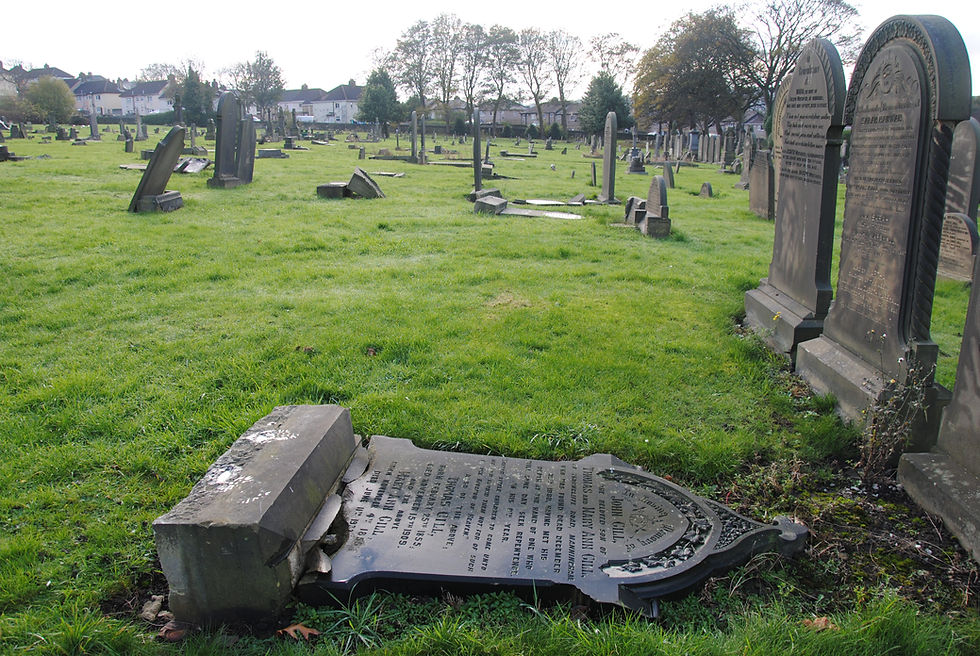
For some time now, I have been trying to achieve something that ought to be relatively straightforward: to secure the professional conservation of the memorial of seven-year-old John Gill at Windhill Cemetery.
John was murdered in Manningham in December 1888. I first became closely involved with his story while researching Stolen Innocents, and since then I have felt increasingly strongly that the surviving memorial to him should not simply be allowed to deteriorate because modern administration cannot find a way through nineteenth-century burial records.
I have offered to fund the conservation work myself. I am not seeking ownership of the grave, burial rights, any alteration to the plot or the replacement of the existing memorial. The intention is simply to preserve what is already there, using appropriate professional conservation.
Unfortunately, progress with Bradford Council has effectively stalled. The difficulty remains the same one I have reported previously. The Council's position is that consent would be required from a legally recognised grave owner, or from somebody able to establish the appropriate legal connection to the plot. The problem is that the ownership records necessary to establish that person do not appear to exist. They are not available to the Council, to me, or apparently to anybody else. That leaves an extraordinary circular problem.
The memorial cannot be conserved without the consent of an owner. The owner cannot be identified because the records required to establish ownership no longer exist, never existed in a recoverable form, or cannot now be found. And because no owner can be identified, nobody can give the consent which the Council says is required.
Meanwhile, the memorial continues to noticeably deteriorate. That cannot, in my view, be a satisfactory long-term answer. I have never expected Bradford Council simply to disregard the law, and I accept that cemeteries present genuine issues involving ownership, liability, safety and the rights of families. What I have been asking for is a lawful and proportionate solution to an exceptional historical case. So far, one has not emerged.
The Council has also referred on a number of occasions to questions of risk. I have therefore submitted a Freedom of Information request asking for the documentary basis of those references in relation specifically to Plot P13 at Windhill Cemetery. I have asked to see any recorded risk assessments, advice, policies, correspondence or mitigation considerations relied upon in reaching the Council's position, or confirmation if no such recorded material exists. If risk is genuinely preventing a professionally funded conservation project, then it is reasonable to understand what that risk actually is and how it has been assessed.
The BBC is now looking at the story
The issue has now moved beyond a private exchange between myself and Bradford Council.
The BBC has expressed an interest in the case, and I am collaborating with Aisha Iqbal as the story develops.
That is important because this is no longer simply about whether one memorial can be repaired. It raises a wider public-interest question about how we preserve historic graves when the legal and administrative records upon which modern cemetery procedures depend have disappeared. The BBC involvement provides an opportunity for the Council's position, the surviving historical evidence and the available legal options to be examined independently. I welcome that scrutiny. If Bradford Council is correct that it has no lawful discretion whatsoever in a case such as this, then that itself raises a serious question. Because it would mean that there may be historic graves across the country which nobody is legally capable of preserving, regardless of their importance, regardless of the condition of the memorial, and regardless of whether somebody is prepared to meet the entire cost.
I have now asked Parliament to look at the problem
For that reason I have also approached Judith Cummins MP. I have made clear that, while I do not agree with Bradford Council's interpretation of the position, I now want the underlying legislative problem examined as well. I have asked Judith to consider whether there needs to be a change in the law, or at least a clearer statutory mechanism, for cases in which grave ownership records no longer exist, never existed in a usable form, or cannot reasonably be found.
There must surely be a distinction between interfering with a privately owned grave where a living owner can be identified, and conserving an historic memorial where every reasonable attempt to establish ownership has reached a documentary dead end. Any legislative solution would have to contain safeguards. Nobody is suggesting that councils should simply allow third parties to alter graves at will.
But there ought to be a lawful route through which a local authority could authorise carefully controlled conservation where, for example, ownership cannot be established after reasonable investigation, no identifiable family interest is being displaced, the work is conservation rather than alteration, and the cost is being met privately.
At present, the apparent absence of such a route risks turning missing Victorian paperwork into a permanent veto on preservation. That seems indefensible.
John Gill should not disappear because a record did
At the centre of all of this remains a seven-year-old boy. John Gill's murder shocked Bradford in 1888. His name survives because newspapers recorded what happened to him, because generations of historians preserved the story, and because a memorial was placed over his grave. That memorial is now part of Bradford's history. I am not asking the Council to rewrite ownership records, hand the grave to somebody else or spend public money restoring it. I am asking for a practical means of ensuring that the stone already there survives. For months I tried to resolve that quietly and locally. I would still prefer a sensible local solution. But if the position really is that neither Bradford Council nor anybody else can legally authorise conservation because the very records needed to identify an owner have disappeared, then the problem is larger than John Gill.
That is why I am now working with the BBC, why I have asked Judith Cummins MP to examine the possibility of legislative change, and why I intend to continue pressing Bradford Council for the documentary and legal basis of its position. History is often lost through neglect.

It should not be lost through an administrative impossibility.


Comments