From Arsenic to DNA: Crime Forensics Then and Now

Modern crime investigation has become so closely associated with laboratories, fingerprints, DNA profiles and digital databases that it is easy to forget how recently much of this technology arrived. A detective attending a suspicious death today enters a world governed by scene preservation, forensic protocols, specialist examination and scientific testing. The same officer transported back to Bradford in the middle of the nineteenth century would find something very different. There would still be a body. There would still be witnesses, suspects, conflicting accounts and physical evidence.
What would be missing was almost everything we now take for granted. Yet Victorian investigators were not entirely working in the dark. By the 1850s, policing, medicine and analytical chemistry were beginning to converge. Figures such as Chief Constable James Withers and the analytical chemist Felix Rimmington, who feature prominently within my own writing about Victorian Bradford, occupied a fascinating moment in that transition. They stood between two worlds: the old world of observation, testimony and instinct, and the emerging world in which science increasingly began to speak for the dead.
The Crime Scene
Today, the scene of a suspicious death may be sealed almost immediately. Access is controlled. Everyone entering or leaving can be recorded. Photographs are taken before anything is disturbed. Clothing, fibres, blood, fingerprints and biological material can be recovered under controlled conditions. Even apparently insignificant objects may be packaged separately to prevent contamination. For James Withers and his contemporaries, the concept of a protected forensic crime scene in the modern sense simply did not exist.
A Victorian room containing a dead body might quickly contain a doctor, police officers, relatives, neighbours, journalists and the merely curious. Furniture could be moved. Clothing might be handled. The body itself could be washed, carried elsewhere or prepared for burial before anyone realised that something important had been destroyed. That did not mean Victorian policemen were careless.
Experienced officers understood that a room could tell a story. The position of a body, a broken window, disturbed furniture, bloodstaining, missing property or the accounts of neighbours could all become important. But the system depended overwhelmingly upon human observation. The investigator was, in effect, the principal recording instrument. A man such as Withers needed to notice what mattered and remember it. Today the scene remembers for us. Photography, video, measurements, DNA recovery and computerised records allow investigators to return repeatedly to evidence long after the original room has been released. For the Victorian detective, once a scene had changed, much of it was gone forever.
The Body as Evidence
The nineteenth century nevertheless saw one enormously important development: increasing recognition that the human body itself was evidence. Doctors had performed post-mortem examinations long before organised policing existed, but Victorian forensic medicine gradually became more systematic.
The location and character of wounds could distinguish accident from assault. Stomach contents might suggest poisoning. Bruising, fractures and internal injuries could contradict what witnesses claimed had happened. But there were severe limitations. There were no X-rays. No CT scans. No toxicological screens capable of detecting minute traces of hundreds of different substances. No DNA.
A Victorian surgeon had his eyes, hands, instruments and experience. To discover what lay inside the body, he usually had to physically open it. This made post-mortem examination an intensely direct form of investigation. The doctor did not look at a digital image of a fractured skull. He examined the skull itself.
He did not send a blood sample to an automated analyser and receive a computer-generated toxicology report. He often had to decide what material to preserve and which specialist might be able to examine it.
This is where men such as Felix Rimmington become particularly significant.
The Rise of the Analytical Chemist
Poisoning presented Victorian investigators with one of their greatest difficulties.
Murder by knife, gun or blunt instrument could leave visible evidence. Poison might leave almost nothing that an ordinary observer could identify. Symptoms could resemble disease. Vomiting, abdominal pain, diarrhoea and collapse might easily be attributed to natural illness. Arsenic was particularly feared because it was widely available and its symptoms could imitate gastrointestinal disease. The analytical chemist therefore became one of the earliest truly scientific forensic specialists.
By the middle decades of the nineteenth century, chemical techniques could demonstrate the presence of certain poisons with increasing confidence. The development of tests such as the Marsh test for arsenic transformed criminal investigation because the accusation of poisoning no longer needed to rest entirely upon suspicious behaviour or medical opinion. Chemistry could produce physical evidence.
For someone such as Rimmington, the laboratory was therefore becoming another crime scene.
A stomach, a piece of food, vomit, medicine or contaminated material could contain a chemical signature invisible to everyone else. The equipment would appear extraordinarily primitive beside a modern forensic laboratory: glass vessels, burners, reagents, balances and careful visual observation. Yet the principle was revolutionary. Matter could testify. That idea lies at the heart of modern forensic science.
What Rimmington Could Not Know
The difference between Rimmington's world and ours is not simply the sophistication of the equipment. It is the enormous expansion of what can now be detected. A modern forensic toxicologist may identify drugs, poisons or metabolites present in extremely small concentrations. Modern laboratories use techniques such as chromatography and mass spectrometry to separate and identify compounds with extraordinary precision. Rimmington instead relied upon chemical reactions. Colour changes, precipitates, deposits and carefully reproduced experiments mattered enormously.
And because a defence lawyer could challenge his conclusions, the scientist needed to explain not merely what he believed but how he had reached that conclusion. That remains true today. The equipment has changed. The underlying requirement has not. Forensic science must survive questioning.
Fingerprints: The Evidence Withers Never Had
Perhaps the most striking difference between Victorian policing and modern investigation is identification.
Withers could question a suspect, compare witness descriptions, trace movements and investigate reputation or motive. What he could not do was recover a fingerprint from a window or bottle and search millions of records within minutes. Although the scientific study of fingerprints developed during the nineteenth century, systematic fingerprint identification in British policing belongs principally to the closing years of the Victorian period and the beginning of the twentieth century. For much of Withers's career, therefore, identification remained a human problem. Did the witness recognise the man? Could somebody place him at the scene? Was an object found in his possession? Did his story contradict another person's account? Modern investigators can ask an additional question: What trace did he leave behind?
That single change transformed criminal investigation.
DNA: The Victorian Detective's Impossible Dream
DNA profiling has taken that principle still further. A microscopic biological trace can associate someone with a location or object decades after an offence occurred. Blood, saliva, semen, hair roots and skin cells can potentially contain identifying genetic material. To a nineteenth-century investigator, this would appear almost supernatural. Imagine explaining to Withers that a person could touch an object and leave behind material capable of distinguishing him from almost everyone else on Earth. Or telling Rimmington that a quantity of biological material too small for him even to see might someday identify a murderer.
Yet there is an interesting irony. Modern forensic science has made microscopic evidence enormously powerful, but it has also made the preservation of a crime scene far more complicated. Victorian investigators did not worry about contaminating DNA because they did not know DNA evidence existed.
A modern investigator must assume that almost every contact may transfer something.
The science has become more powerful because our understanding of evidence has become more demanding.
John Gill: Would Modern Forensics Have Changed the Verdict?
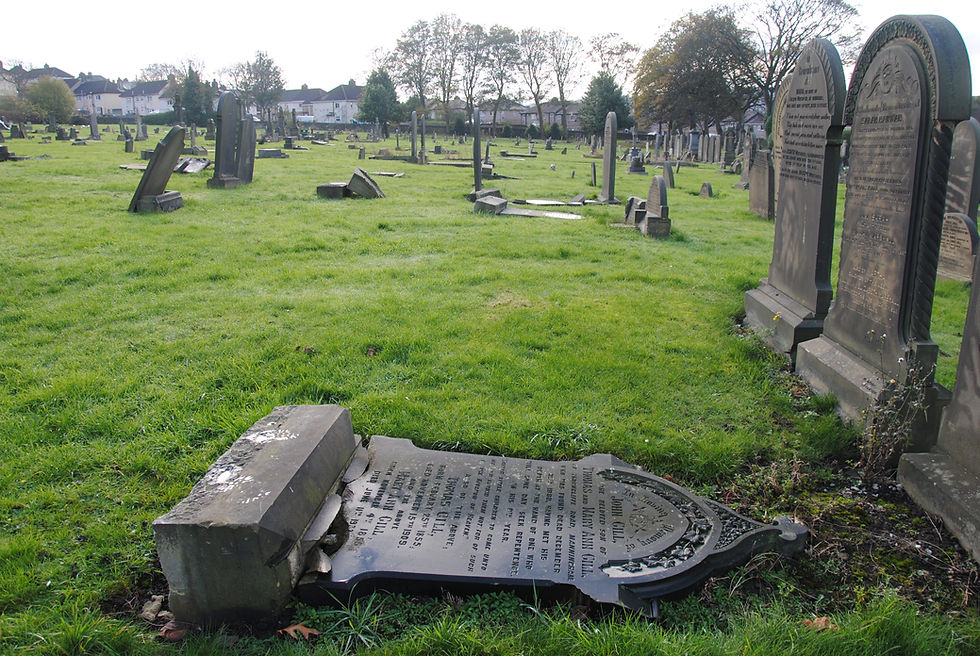
This question becomes particularly intriguing when applied to one of Bradford's most disturbing unsolved crimes , the murder of the young John Gill, the case at the centre of my book Stolen Innocents.
The Victorian investigators were confronted with a crime of extraordinary brutality, but they were forced to investigate it with extraordinarily limited scientific assistance. They could examine injuries. They could question witnesses. They could reconstruct movements and search premises. They could consider opportunity, behaviour, geography and inconsistencies in a suspect's account.
What they could not do was ask the questions that would dominate a modern murder investigation.
Whose blood was present? Was there blood belonging to anyone other than the victim? Were hairs or fibres transferred between victim and offender? Was foreign biological material present upon John Gill's clothing or body? Had the killer left fingerprints? Could microscopic material connect the place where the boy was killed with another location? Could wounds be analysed using modern forensic pathology to establish more precisely the sequence in which they were inflicted, the weapon or weapons involved, and perhaps something about the person who inflicted them? None of those avenues was available to Withers and his officers. That matters because the Gill investigation ultimately became heavily dependent upon circumstantial evidence, witness testimony and interpretation. William Barrett was prosecuted and acquitted. Later suspicion has fallen elsewhere, including upon the possibility of another offender whose movements, history and subsequent crimes raise uncomfortable questions. In Stolen Innocents, I explored the possibility that the murderer might have been someone other than the man placed before the jury. One particularly troubling possibility is Turner, whose later murder of Barbara Waterhouse, geographical connections and elements of his offending make him difficult to dismiss entirely. But difficulty in dismissing a suspect is not proof. That distinction is important. Modern forensic science might have strengthened the case against Barrett. It might have destroyed it before he ever reached a courtroom.
It might have connected Turner to John Gill. Equally, it might have excluded Turner completely and demonstrated that more than a century of suspicion had been misplaced. Or it might have identified somebody whose name has scarcely entered the historical record. That is the power of forensic science at its best. It does not exist to confirm the investigator's theory. It exists to test it.
Had John Gill been murdered in the twenty-first century, the investigation would also have extended far beyond the body itself. CCTV, transport records, telephone data, digital communications, automatic number-plate recognition and computerised intelligence systems could reconstruct the movements of victim and suspects with a precision Withers could scarcely have imagined. Even without those modern technological footprints, properly preserved physical evidence could have transformed the investigation.
A single hair. A trace of blood. Skin beneath a fingernail. A fibre transferred between two garments.
Evidence so small that a Victorian investigator could have held it in his hand without knowing it existed might today alter the entire direction of the case. We cannot legitimately say that modern science would have solved the murder of John Gill. But it is reasonable to ask whether the conclusion reached by the Victorian investigation would have been the same. Perhaps the greatest tragedy is that the evidence capable of answering that question may once have existed. They simply did not yet possess the science with which to hear it.
The Detective Has Not Disappeared
It would be tempting to conclude that modern technology has made the Victorian detective obsolete.
It has not. DNA does not explain motive. A fingerprint does not necessarily explain why somebody touched an object. A toxicology result may prove that poison was present without proving who administered it. Digital records may establish where a telephone travelled without explaining what its owner intended. The fundamental work of investigation therefore remains surprisingly familiar. Who was present?
Who benefited? Who had the opportunity? Whose account can be corroborated? Who is lying? What happened before the death? What happened afterwards? Those are questions Withers would immediately recognise. Technology has changed the answers available to investigators, but it has not eliminated the need to ask the right questions.
The Importance of the Coroner
Another institution linking the Victorian and modern worlds is the coroner. Victorian coroners' inquests could bring together witnesses, doctors, police officers and scientific experts. Evidence was heard publicly and a jury might be required to determine how someone had died. The inquest therefore became one of the places where emerging forensic science entered public life. A chemist such as Rimmington might explain the results of an analysis. A doctor might describe injuries found during a post-mortem. Withers or one of his officers could outline the circumstances discovered during an investigation. What we now regard as separate forensic disciplines were beginning to meet inside the same courtroom. Medicine chemistry policing, witness testimony. Together they attempted to reconstruct an event nobody had necessarily seen.
That remains essentially what forensic investigation does today.
From Observation to Measurement
Perhaps the greatest change between Victorian forensics and modern forensic science can be summarised quite simply. The nineteenth-century investigator primarily observed. The modern investigator increasingly measures. Withers observed behaviour, circumstances and contradictions. Rimmington measured chemical reactions and attempted to turn them into demonstrable proof. Modern forensic scientists have extended that principle almost beyond recognition. They measure DNA fragments, drug concentrations, microscopic fibres, digital timestamps, blood patterns, tool marks and countless other traces. But the philosophical connection between the two periods is stronger than it first appears.
Both are attempting to make the silent speak.
The Birth of Modern Forensics
When writing about Victorian crime, it is therefore misleading to portray nineteenth-century investigation simply as primitive policing awaiting the arrival of modern science. Something much more interesting was happening. Modern forensic investigation was being born. Men such as Withers represented the increasingly professional police investigator: organised, methodical and responsible for assembling evidence rather than merely arresting suspects. Men such as Rimmington represented something equally important: the emerging belief that scientific analysis could reveal truths that neither witnesses nor criminals could easily conceal. Their world lacked fingerprints, DNA, digital databases, sophisticated toxicology and modern pathology. But the intellectual foundations were already present. Observe carefully. Preserve what may matter. Question assumptions. Test evidence. And prove what can be proved. The instruments have changed enormously since the middle of the nineteenth century. The purpose has not.

A crime leaves traces.
The investigator's task, whether standing beneath the gaslight of Victorian Bradford or inside a twenty-first-century forensic laboratory, is to discover what those traces mean.



Absolutely fascinating insight and it does make you wonder how things would’ve turned out differently if we knew them what we know now