From Page to Public Record: The Telegraph & Argus Feature

Why the John Gill Story Still Matters Today
There are moments in the life of a project when it moves beyond private work and enters the public domain. The recent coverage in the Telegraph & Argus marked such a moment. For a story rooted in Victorian Bradford, this transition carries particular significance. It represents not merely exposure, but recognition, an acknowledgment that the past, when properly examined, retains relevance in the present.
A Story That Refuses to Settle
The case at the heart of Stolen Innocents is not simply a historical curiosity. It is part of the wider history of John Gill, a murdered child in Bradford in 1888, and reflects a time in which systems were still forming and the protection of the vulnerable was often inconsistent. What emerged during both the research and the writing was a persistent sense that this was not a story that had ever been fully resolved in the public consciousness. It lingered. The Telegraph & Argus article brought that sense into sharper focus, framing the narrative not just as historical fiction, but as part of Bradford’s historical record, one that continues to raise questions about memory, responsibility, and preservation.
Local History and Public Responsibility
One of the more striking aspects of the coverage was the broader issue it touched upon: the preservation of local history. Across Bradford, and particularly in places such as Windhill Cemetery, there are graves:
unmarked
deteriorating
disconnected from any identifiable ownership
In many cases, records are incomplete, and responsibility is unclear. The rediscovery of such sites, and the stories attached to them, often relies on individual initiative rather than institutional process. This raises a fundamental question: Who is responsible for remembering?
Without a practical mechanism for preservation, historic memorials risk being lost, not through neglect alone, but through the absence of a clear framework for action.
Bridging Past and Present
The value of the coverage lies not in promotion, but in connection. By bringing the story of John Gill to a contemporary audience, the Telegraph & Argus has bridged the gap between nineteenth-century events and present-day awareness. It has placed the narrative back into the community from which it originated.
This is where such stories belong , not confined to archives or footnotes, but understood as part of a continuing dialogue about place, identity, and history.
Why It Still Matters
At its core, Stolen Innocents engages with themes that remain relevant:
vulnerability
justice
institutional responsibility
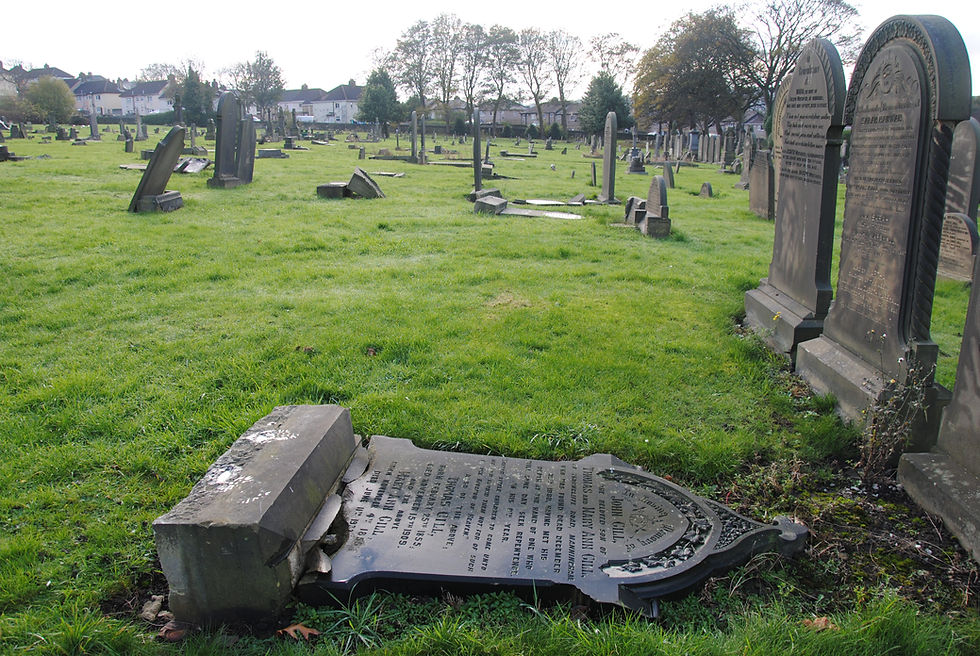
These are not abstract concerns. They are rooted in real lives, real places, and real consequences. The condition of the John Gill grave in Windhill Cemetery is not simply a matter of historical interest, it reflects a wider issue affecting historic graves across the UK, where ownership is unclear and preservation becomes difficult to achieve.
A Beginning, Not an End
Public attention, once gained, is rarely permanent. It must be built upon. The Telegraph & Argus feature represents a beginning, an opportunity to extend the conversation, encourage further interest in Bradford’s Victorian history, and ensure that stories such as this are not lost to time. If anything, it reinforces the central premise behind the work itself:
👉 The past is not silent.
👉 It simply requires someone willing to listen, examine, and bring it forward.
🔗 Read the original article:https://www.thetelegraphandargus.co.uk/news/26031640.bradford-man-calls-solution-preserve-john-gill-grave/



Comments