Managing decay

An Update on John Gill’s Grave, and the Publication of The Bradford Poisonings
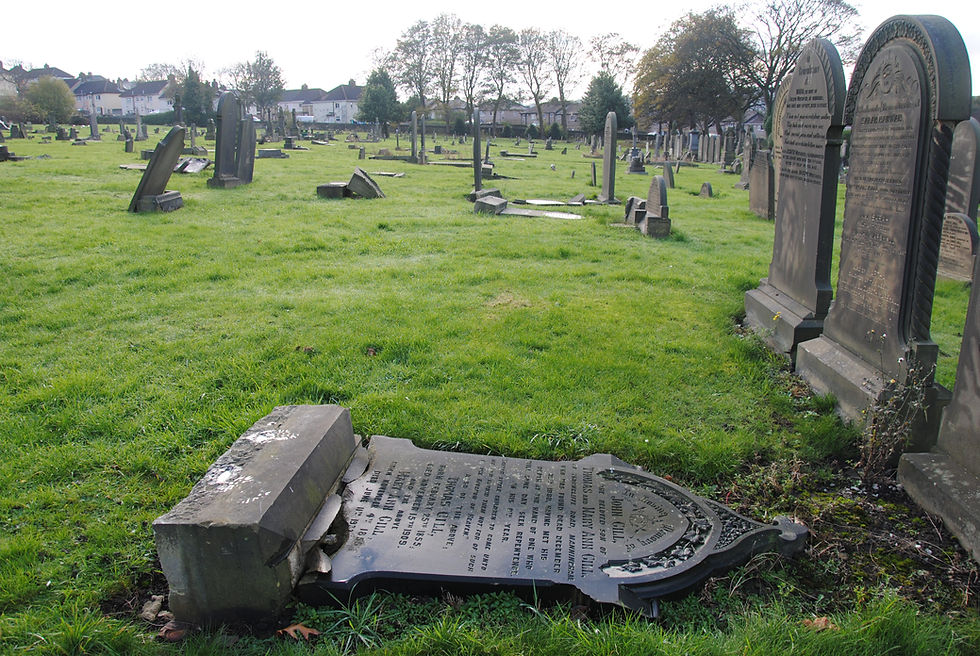
I want to manage dignity in death, and preserve memories, but what I see is a policy to manage decay:
Over recent months, many people have followed the discussions surrounding the grave of John Gill and the wider questions this has raised about remembrance, responsibility, and what becomes of memorials when no direct descendants can be identified.
I felt it was important to provide a further update; the situation itself remains unresolved.
Discussions and correspondence continue, there has been no movement behind the scenes at Bradford Council, there is still no final pathway agreed that would allow restoration work to proceed in the way originally hoped. What began as a simple wish to restore dignity to a neglected grave has gradually uncovered a far more complex issue: what happens when history survives, but family lines do not?
That question remains at the centre of this.
Throughout the process, I have tried to approach matters carefully and respectfully. My intention has never been confrontation for its own sake, nor ownership, nor rights of burial, nor any form of personal claim. The goal has remained unchanged from the beginning: to prevent the quiet disappearance of a child’s memory beneath bureaucracy, uncertainty, and the slow passage of time.
There are encouraging signs that the wider issue is at least now being recognised and discussed more openly than before. If nothing else, this process has highlighted what appears to be a genuine policy gap when graves fall into a form of historical limbo, where descendants cannot reasonably be traced, yet public interest and historical significance remain.
I continue to believe that memorial preservation should not depend entirely upon the survival of bloodlines.
History belongs, at least in part, to communities. At the same time, I remain conscious that those involved on all sides are dealing with difficult and often sensitive responsibilities. It is important that this conversation stays measured, factual, and constructive. Public pressure can easily become counterproductive if emotion overtakes purpose.
For my part, I intend to continue documenting the process openly and honestly. Alongside all of this, today also marks an important personal milestone.
I have now officially published The Bradford Poisonings: When Sweetness Turned to Death.
The book is currently moving through Amazon’s publication process and should become publicly available within the next 24–72 hours.
This work has occupied a significant part of my life over the past year. Based upon the 1858 Bradford arsenic poisoning tragedy, it reconstructs one of the most devastating public health disasters in Victorian Britain: the accidental contamination of peppermint lozenges with arsenic, leading to widespread illness and death across the town.
What initially drew me to the story was not merely the tragedy itself, but what it revealed about Victorian Bradford, a rapidly expanding industrial town struggling with questions of regulation, accountability, poverty, commerce, and public trust. The deeper I researched, the more I realised the case was not simply about poison. It was about systems. It was about oversight. It was about ordinary people caught inside failures they neither caused nor fully understood. In many ways, the themes unexpectedly overlap with some of the concerns surrounding John Gill’s grave: how societies remember, how institutions respond, and how easily vulnerable people can disappear into administrative silence unless someone chooses to keep asking questions.
The novel combines historical records, contemporary newspaper accounts, forensic reconstruction, and narrative interpretation to bring the events back to life in a way I hope remains respectful both to the victims and to Bradford’s history itself.
I owe enormous thanks to those who have supported the project, particularly during the long editing and production process.
I am especially grateful to:
Jennifer Cowling, for her detailed manuscript review and careful scrutiny of chronology and structure.
Tim Hardy, whose cover design captured precisely the atmosphere I hoped the book would carry.
The many local historians, archivists, genealogists, and supporters who preserve Bradford’s history and continue ensuring these stories are not forgotten.
The timing of the publication feels strangely appropriate. Both the John Gill discussions and The Bradford Poisonings ultimately come back to the same idea:
That people should not simply vanish from memory because time has passed.
Victorian Bradford was full of ordinary lives, ordinary families, and ordinary tragedies. Yet those lives still mattered. They still do.
Further updates regarding both the grave restoration discussions and the release of The Bradford Poisonings will follow soon.
John Lawless The Cobblestone Chronicle Press



Congratulations on the new release :-)