John Gill Died Twice

John Gill Died Twice. Once in 1888 and Again in 2026, When His Memory Was Left to Fade
There is a particular kind of loss that does not happen all at once. It does not arrive with ceremony or record. There is no certificate, no formal acknowledgement. It occurs slowly through weather, through time, and, occasionally, through the quiet absence of permission.
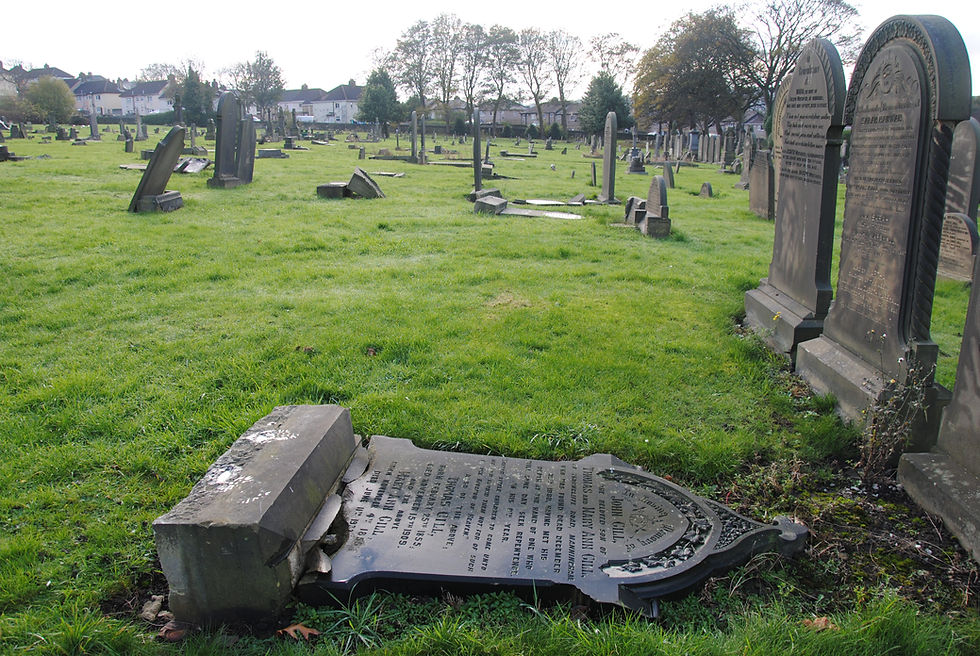
My intention began simply. A fallen cracked monument. A name still legible. A life that could, with care, be preserved in stone for those who might one day come looking.
My approach was measured. Enquiries were made. Processes followed. I did not seek to take ownership, only to act responsibly where no clear custodian remained. Safeguards were offered. Indemnities proposed. Every step taken with the expectation that a practical solution could be found.
Instead, I encountered a boundary that is not easily crossed. There are moments in local history when the past does not simply rest, it lingers, exposed to time, weather, and, occasionally, indifference. My recent efforts have centred on one such place: a cemetery whose stones speak not only of those buried beneath them, but of the community that once stood above them. My intention was straightforward. Where a monument had fallen into disrepair, and where no clear owner could be identified, I sought a way, lawful, respectful, and properly recorded, to restore John Gills memory, Bradford heritage and the stone that is the last remaining monument to John's past
This was never about ownership. It was about stewardship. From the outset, I approached Bradford Council in good faith. I made enquiries. I asked what permissions would be required. I offered, where appropriate, to indemnify against future claims, should a descendant one day come forward. My aim was not to bypass process, but to work within it.
What I encountered instead was a system defined less by what it permits, and more by what it cannot risk.
The central difficulty lies in the absence of a living claimant. The right to a grave space may once have been granted, sometimes described as “in perpetuity”, but in practical terms, that right becomes indistinct over generations. Records fade. Families disperse. Names lose their living connection. What remains is a monument without a voice to speak for it.
And in that silence, policy steps in. The position, as it has been explained, is cautious to the point of immobility. Without demonstrable ownership, intervention becomes problematic. Even where restoration is well-intentioned, it risks being interpreted as interference. The result is a default position: to leave the monument as it is, to disintegrate and fade. At first glance, this may appear neutral. In reality, it is anything but. Stone does not remain unchanged. Left unattended, it leans. It fractures. It falls. What begins as preservation through inaction becomes, over time, a quiet endorsement of decay.
This is the point at which intention and outcome diverge. I began this process believing that a practical solution could be found, that with the right safeguards, the past could be preserved without compromising the present. What has become increasingly clear is that the framework does not readily allow for such solutions. It is not designed for absence; it is designed for ownership.
And where ownership cannot be proven, responsibility does not transfer, it dissolves. That leaves a difficult conclusion. In cases where no descendants can be identified and where no mechanism exists to permit responsible third-party intervention, the likely future of many monuments is not restoration, but gradual loss. Not through neglect in the active sense, but through a system that has no means to act.
This is not a criticism of individuals, nor of intentions. Those I have engaged with have been measured and professional, working within the boundaries they have set before them. The issue lies elsewhere, in the structure itself, and in the limits it imposes.
The question that remains is a broader one. If a community values its history, and if that history is physically embodied in places such as these, what provision should exist when the line of direct responsibility has ended? At what point does heritage become collective, rather than private? And who, if anyone, is permitted to act on its behalf?
For now, those questions remain unanswered. The stones, meanwhile, continue their slow journey of decay over time


Well written. THANKS 😊
Riaz
An excellent article and raised a good point, the council should do more to preserve our heritage and to dignify a death of victims of crime.